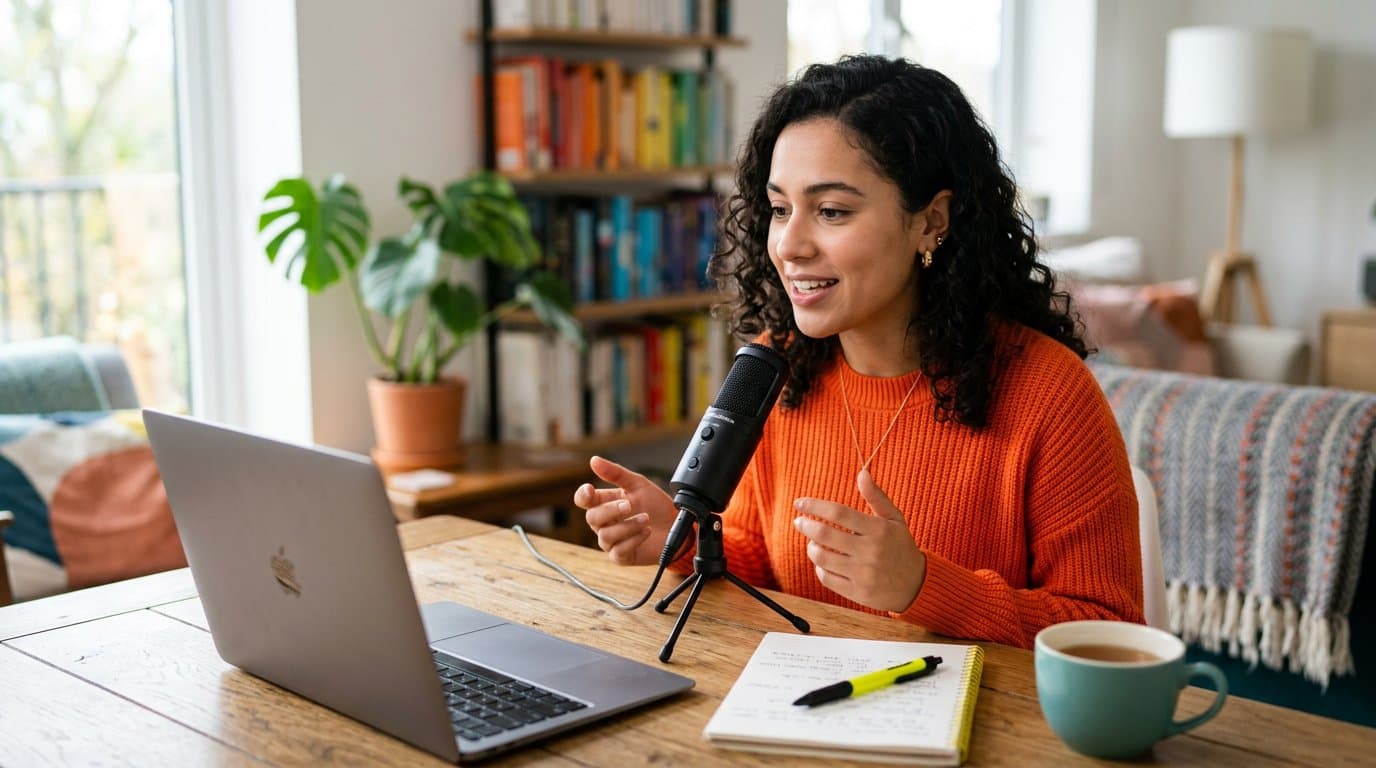
Many learners begin their language journey searching for an effective multimedia method that quickly bridges the gap between passive comprehension and active speech. Watching instructional lectures or listening to native dialogues helps build an ear for the language, but moving from comprehension to authentic fluency requires deliberate, structured practice.
Mastering English pronunciation and spontaneous speaking demands active techniques that turn standard video resources into practical vocal workouts. By incorporating deliberate imitation, vocal shadowing, and AI-driven feedback, you can systematically elevate your spoken delivery for daily communication and international examinations like IELTS and TOEFL.
Why Video-Based Learning Accelerates Fluency
Traditional audio tracks lack the visual cues essential for authentic pronunciation. When you watch targeted video content, you observe mouth shape, lip movement, tongue placement, facial expressions, and body language alongside speech rhythm.
According to pronunciation resources published by IDP IELTS, mimicking native speakers through multimedia while focusing on natural rhythm, sentence stress, and intonation helps candidates build clearer, more intelligible pronunciation.
Video-based learning provides three core physiological advantages:
- Visual Articulation: Observe how native speakers physically form challenging sounds, such as dental fricatives (/θ/ and /ð/) or liquid consonants (/l/ and /r/).
- Connected Speech Insights: Hear and see how words blend together in natural dialogue through elision, assimilation, linking sounds, and weak forms.
- Contextual Meaning: Learn how pitch variation, pauses, and facial expressions alter the nuance of idiomatic phrases and pragmatic discourse.
Popular educational channels like Learn English With TV Series demonstrate how authentic media teaches natural cadence, conversational timing, and cultural idioms far better than static textbook transcripts.
The Shadowing Technique: How to Study with Video
Passively streaming English content in the background produces minimal gains in spoken output. To build vocal muscle memory and automate natural rhythm, apply the shadowing technique—a cognitive speech-training method where you listen to native speech and repeat it aloud in real time with minimal delay.
Follow this systematic five-step framework:
- Clip Selection: Choose a short 30–60 second clip from an authentic video or lecture.
- Comprehension Check: Watch once with subtitles to verify vocabulary and overall context.
- Phonological Mapping: Watch again without subtitles, noting word stress, thought groups, and breathing pauses.
- Simultaneous Shadowing: Speak aloud along with the speaker, matching their exact pace, intonation, and emotional tone.
- Vocal Auditing: Record your performance and compare it directly to the source audio to detect pitch mismatches or slurred consonants.
Regular shadowing trains the articulatory muscles to adopt standard English cadence. It systematically reduces unnatural hesitation pauses and improves overall speech rate—a decisive factor in oral proficiency exams.
Pronunciation and the Four Pillars of Exam Assessment
For test-takers preparing for standardized English assessments, fluency is measured against rigorous, standardized rubrics. As outlined by official test co-owners IELTS.org and the British Council, the Speaking examination evaluates four distinct criteria:
- Fluency & Coherence: Speaking smoothly without excessive hesitation, self-correction, or unnatural pauses, while structuring thoughts with logical discourse markers.
- Lexical Resource: Using a broad range of vocabulary, precise collocations, and natural idiomatic language appropriately.
- Grammatical Range & Accuracy: Employing both simple and complex grammatical structures with consistent control.
- Pronunciation: Using a full range of phonological features—including word stress, sentence intonation, and rhythm—so speech is effortless to understand throughout.
Similarly, delivery standards established by ETS for the TOEFL Speaking section evaluate clear pacing, fluid delivery, and appropriate intonation contours. Using video models to master sentence-level stress ensures your speech sounds natural and engaging rather than monotone or robotic.
Closing the Gap: From Passive Watching to Active Speaking
While video lessons provide exceptional phonological models, they lack one critical component: objective, personalized evaluation. Watching an instructor explain pronunciation does not confirm whether your own speech production meets examiner standards.
Modern learners bridge this gap by combining video input with instant AI-driven scoring. Advanced preparation platforms like acsent.ai provide the targeted, examiner-level analysis needed to refine spoken English. Instead of guessing your band score or paying high hourly rates for private tutoring, you can use specialized tools to diagnose your exact phonetic and structural weaknesses.
To evaluate your spoken fluency against official descriptors, you can try AI-powered IELTS Speaking practice at acsent.ai/question-bank/ielts/speaking and receive instant feedback on pronunciation, lexical range, and grammatical accuracy across Part 1, Part 2, and Part 3 prompts.
4 Practical Habits for Daily Pronunciation Mastery
To achieve measurable gains in speaking fluency, incorporate these four habits into your daily study routine:
1. Chunk Speech into Thought Groups
Native speakers do not speak word-by-word; they deliver language in "thought groups" or meaningful clusters separated by brief micro-pauses. Select a sentence from a video and mark the natural phrasing:
If you want to improve your fluency / you need to practice every day / without worrying about making mistakes.
2. Exaggerate Sentence Stress
English is a stress-timed language. Content words (nouns, main verbs, adjectives) carry primary stress and higher pitch, while function words (prepositions, auxiliary verbs, articles) are reduced to weak forms. When practicing with video dialogue, exaggerate stressed syllables to train proper contrastive rhythm.
3. Record Independent Responses
Move beyond imitation by recording your own spontaneous responses to cue card topics. Listen back to identify dropped final consonants, monotone delivery, or overused filler words such as "um", "like", and "uh".
4. Practice Under Timed Exam Conditions
Fluency often deteriorates under exam pressure unless practiced within strict time limits. Practice speaking on unfamiliar academic topics for a full two minutes without pausing. To test your overall readiness under realistic conditions, take a free IELTS mock test at acsent.ai/test to evaluate your performance across all four test sections.
Transforming passive video watching into active, deliberate speech production is the most efficient path to genuine English fluency. By pairing video shadowing with instant, criteria-aligned feedback from platforms like acsent.ai, you build the exact pronunciation, pacing, and lexical command required to speak confidently and achieve your target band score.