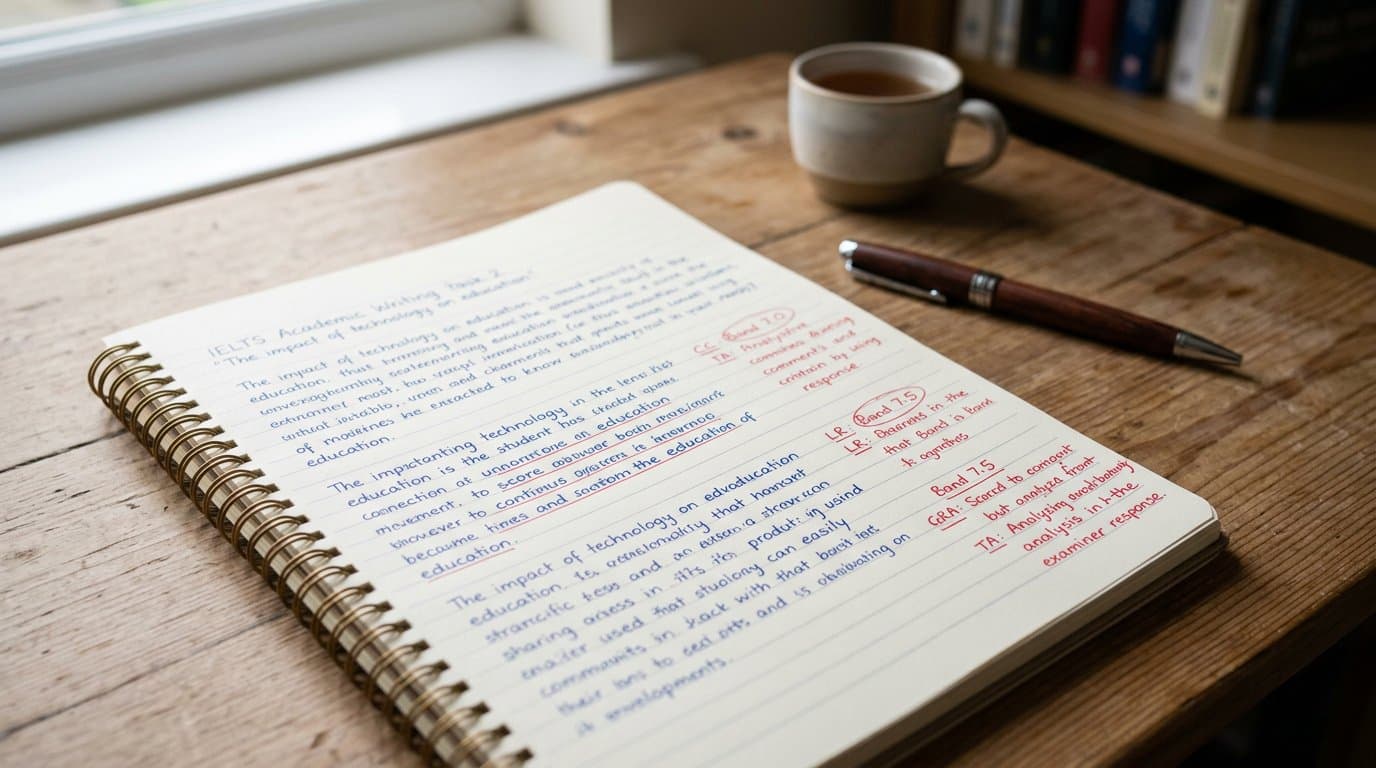
The top AI tools for IELTS Writing Task 2 feedback are acsent.ai, UpScore.ai, SpeakMetry, Cathoven AI, and IELTSWritingChecker. These platforms evaluate essays using automated scoring engines designed to emulate certified examiners, pinpoint grammatical weaknesses, and diagnose structure problems.
How We Evaluated and Ranked These Tools
To identify the best IELTS writing feedback AI for Task 2, we evaluated platforms against four core standards established by official test co-owners like the British Council and IDP:
- Alignment with Official Band Descriptors: IELTS Writing Task 2 essays are evaluated across four equally weighted criteria: Task Response (TR), Coherence & Cohesion (CC), Lexical Resource (LR), and Grammatical Range & Accuracy (GRA). We prioritized tools that explicitly benchmark against the official IELTS Writing band descriptors and key assessment criteria.
- Actionability of Feedback: Tools must do more than display an estimated band score; they must identify specific sentence-level grammar mistakes, vocabulary repetition, and paragraph logic gaps.
- Scoring Consistency: The evaluation must reliably mirror examiner grading standards without inflating or deflating band scores.
- Platform Capabilities: We evaluated whether tools support complete exam simulations, timed writing modes, and multi-skill preparation.
1. acsent.ai
What It Is
acsent.ai is a comprehensive AI-powered IELTS preparation platform offering automated essay evaluation alongside full mock test simulations. When you submit a Task 2 essay, the platform evaluates your work across Task Response, Coherence & Cohesion, Lexical Resource, and Grammatical Range & Accuracy, delivering immediate criterion-by-criterion band estimates and actionable correction notes.
Who It Is Best For
Self-study candidates, working professionals, and language school students who need end-to-end IELTS preparation combining detailed essay corrections with realistic test conditions.
Concrete Strength
acsent.ai provides targeted, paragraph-level diagnostics rather than broad advice. Instead of simply telling you to diversify vocabulary, the system highlights repetitive phrasing, suggests high-band lexical alternatives in context, and identifies precisely where an argument loses coherence. Users can also take complete, timed mock tests on acsent.ai to simulate official exam pressure.
Concrete Limitation
The platform is designed exclusively for standardized English proficiency exams (IELTS and TOEFL), meaning it does not evaluate general creative or long-form academic writing outside standard test formats.
2. UpScore.ai
What It Is
UpScore.ai is an automated essay-checking tool specifically trained on IELTS Writing Task 1 and Task 2 submissions. It evaluates user responses against historical benchmarks to predict overall and sub-criterion band scores.
Who It Is Best For
Test-takers who want an empirical estimate of their current band score based on historical essay data.
Concrete Strength
UpScore.ai provides transparent scoring breakdowns across all four assessment areas, showing users how closely their writing aligns with sample essays graded between Band 4.0 and Band 8.5.
Concrete Limitation
The tool focuses primarily on band score prediction and basic corrections, offering fewer interactive revision exercises and lacking a broader multi-skill testing ecosystem.
3. SpeakMetry
What It Is
SpeakMetry is a browser-based essay analyzer built specifically for IELTS Writing Task 2 prompts. Users paste their prompt and essay into the interface to generate an immediate diagnostic report.
Who It Is Best For
Students seeking a quick, no-friction essay check with immediate suggestions for higher-band phrasing.
Concrete Strength
The platform includes an automated rewriting feature that presents high-band sentence restructurings alongside the original text, demonstrating how to elevate simple grammatical patterns into complex structures.
Concrete Limitation
Its feedback on Task Response can be generic, occasionally missing nuanced prompt requirements such as whether both views in a discussion prompt were equally balanced.
4. Cathoven AI
What It Is
Cathoven AI is an educational language-analysis engine that dissects IELTS essays through detailed Common European Framework of Reference for Languages (CEFR) and IELTS rubric mapping.
Who It Is Best For
ESL instructors and analytical learners who want deep grammatical analysis and vocabulary level-tagging from A1 to C2.
Concrete Strength
It delivers comprehensive breakdowns of lexical sophistication, categorizing every word by CEFR tier so students can eliminate low-level vocabulary and reduce overused words.
Concrete Limitation
The detailed interface can overwhelm test-takers who just want straightforward feedback on how to fix argument structure and paragraph transitions.
5. IELTSWritingChecker
What It Is
IELTSWritingChecker is a lightweight evaluation tool designed for fast turnaround checks on both Academic and General Training Writing tasks.
Who It Is Best For
Beginners who want rapid band estimates and basic spelling, punctuation, and grammar corrections without navigating a complex dashboard.
Concrete Strength
The interface is streamlined and straightforward: paste your prompt, paste your response, and receive an estimated band score along with highlighted surface-level errors within seconds.
Concrete Limitation
The qualitative analysis for Coherence & Cohesion and Task Response is limited, providing minimal guidance on paragraph development or logical topic extension.
How to Choose the Right IELTS Task 2 AI Tool
Selecting the right feedback platform depends on your target band score, current weaknesses, and overall study plan. If you need comprehensive analysis that mirrors real examiners across all four criteria while offering a complete study ecosystem, get instant AI feedback on your IELTS Writing at acsent.ai to address structural and grammatical weaknesses before exam day. If your primary struggle is Lexical Resource and you want to analyze word tiers in detail, Cathoven AI provides deep linguistic breakdowns, whereas SpeakMetry is suitable for rapid sentence rewrites. Whichever tool you choose, ensure you practice under strict 40-minute time limits and write at least 250 words to simulate authentic Task 2 testing conditions accurately.